|
1861
New powerful forts constructed at Coalhouse, Shornemead and Cliffe planned to work in unison and provide a first line of defence for the protection of the river approach to the Capital and Woolwich Arsenal. A second line was provided by upgrading the forts at Tilbury and Gravesend. 1865 Colonel, later General, Charles Gordon supervised the later stages of the construction of these new Thames defences. 1874 After several changes of plan, Coalhouse Fort completed and armed with 3 x 9 inch Rifled Muzzle Loaders (RML'.s), shell-firing guns in the open battery, and 11 inch RML's in the casemates. These bombproof casemates had 5-foot thick roofs of brick and concrete with granite fronts and iron shields. 1877 Four 12.5 inch RML's added to the armament each weighing 38 tons with a range of 5,500 yards. The intended garrison was 6 officers and 180 N.C.O.s and men but these figures were not realised until the beginning of World War I. 1891 An entirely new East Tilbury Battery was constructed between river and village street. It was designed for 4 x 6-inch breech loading guns and 2 x 10-inch breech loading guns on disappearing mountings. These were new breech-loaders using smokeless powder with a range of 6,000 yards, which made the cumbersome RML's obsolete. 1893 Wing battery constructed just south of Coalhouse Fort for 4 x 6 pounder quick firing guns, which fired at 25 rounds per minute, mainly for minefield defence. Similar batteries were established at Cliffe and Shornemead. 1903 The disappearing mountings of the 6 inch breech loading guns at East Tilbury Battery were replaced by conventional ones and the 10 inch breech loading guns declared obsolescent. Coalhouse Fort casemates were abandoned as gun housings. The east facing part of the roof was strengthened with huge concrete pillars and 4 x 6-inch breech-loading guns with a 7 mile range were installed. On the more southerly part of the roof, 4 x 12 pounder quick firing guns were installed with a range of 4½ miles. The 6 pounder guns in the wing battery were removed and replaced by searchlights. Earth was banked against the casemates to give extra protection and to reduce the profile, although it seems that some of the 12.5 inch RML's remained until 1907. By this date the 12 pounder Battery on the roof of Coalhouse Fort was obsolescent. 1914 Main defences established further down river. Coalhouse Fort used as an examination battery in conjunction with Cliffe and Shornemead. Remotely controlled mines laid in the river between the forts. Thames and Medway defences manned by No. 2 Coy. London Electrical Engineers and No. 2 Coy. Royal Garrison Artillery. |
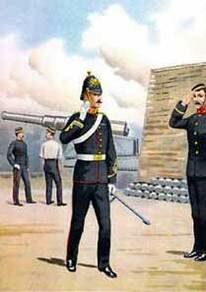
An officer taking the salute in front of an RML
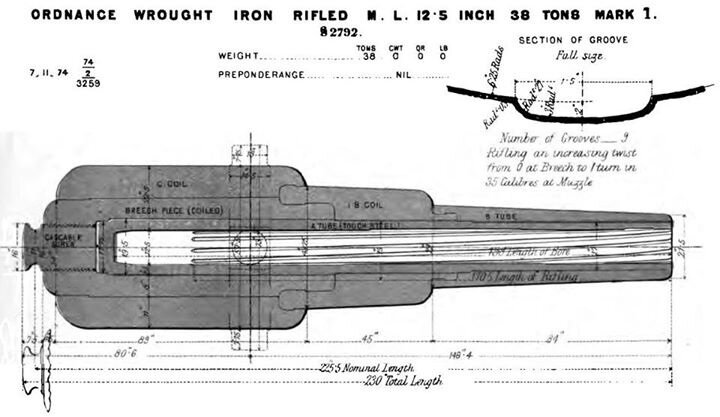
A technical detail of an RML
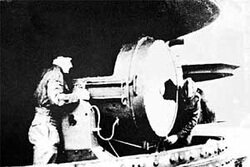
Crew manning one of the searchlights fitted in the ex-lookout positions
|