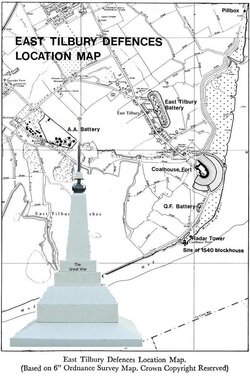
Strategically placed on the Essex peninsular, Coalhouse Point, this unique site has been developed as a defensive position from 1402. With a near 180 degree arc of fire across the bend in the River Thames at Stanford-le-Hope and back towards London this location was chosen as earthwork defences, Henrician blockhouse and the Victorian Coastal Defence fortress which stands today.
Lord Palmerston, Prime Minister twice during the 19th century, helped promote the idea of a defensive wall around the British Isles to protect from the perceived European threat. These fortresses have come to be known as Palmerston's Follies as none of them fired a shot in anger until World War II. Many felt they were a waste of money (Coalhouse Fort, for example, cost around £130,000 to build), but in hindsight they could have worked from a deterrent point of view.
The fort which stands today has undergone many changes since its Victorian footprint. Originally, the fort was a Haxo Casemate design where it housed 11 Rifle Muzzle Loaders (RML's) in its 22 casemates plus three larger RML's in open batteries. Later, Quick-Firing (QF) guns were added to the roof and, during WWII, two 5.5" guns from HMS Hood were deployed along with an Anti-Aircraft (AA) gun - the only weapon to fire in anger at the approaching Luftwaffe during the Blitz.
Lord Palmerston, Prime Minister twice during the 19th century, helped promote the idea of a defensive wall around the British Isles to protect from the perceived European threat. These fortresses have come to be known as Palmerston's Follies as none of them fired a shot in anger until World War II. Many felt they were a waste of money (Coalhouse Fort, for example, cost around £130,000 to build), but in hindsight they could have worked from a deterrent point of view.
The fort which stands today has undergone many changes since its Victorian footprint. Originally, the fort was a Haxo Casemate design where it housed 11 Rifle Muzzle Loaders (RML's) in its 22 casemates plus three larger RML's in open batteries. Later, Quick-Firing (QF) guns were added to the roof and, during WWII, two 5.5" guns from HMS Hood were deployed along with an Anti-Aircraft (AA) gun - the only weapon to fire in anger at the approaching Luftwaffe during the Blitz.